For the third time you're explaining that the text should be simple. That every post also needs a short description. That files go into a separate folder, because the other one is connected to the live site.
The AI takes the note enthusiastically. "Of course, I'll keep that in mind."
You open a new chat. No description. Files land where they did last time. Time to start the briefing over, while the coffee is still warm.
If you work with AI on anything longer than one evening, some of what you've agreed on should live outside the conversation. In a short note you hand over with the next task. A plain text file works. Markdown works too: it's just text with headings, easy to edit and move around.
"I already told you" is a bad system
A conversation gets messy fast. First you wanted a page with a light background. Then dark after all. For a while you considered a paid integration, until it turned out that exporting to a file is enough to start. Somewhere in between, the agent suggested three things you never even replied to.
Now hand that history to another model and ask it to guess what still applies.
Just saving the conversation doesn't solve the problem. You need the current decisions, without the abandoned ideas and the whole process of getting there. Especially when you switch tools or come back to the project after a month. Then you'll also want to know what the author meant. The author is you.
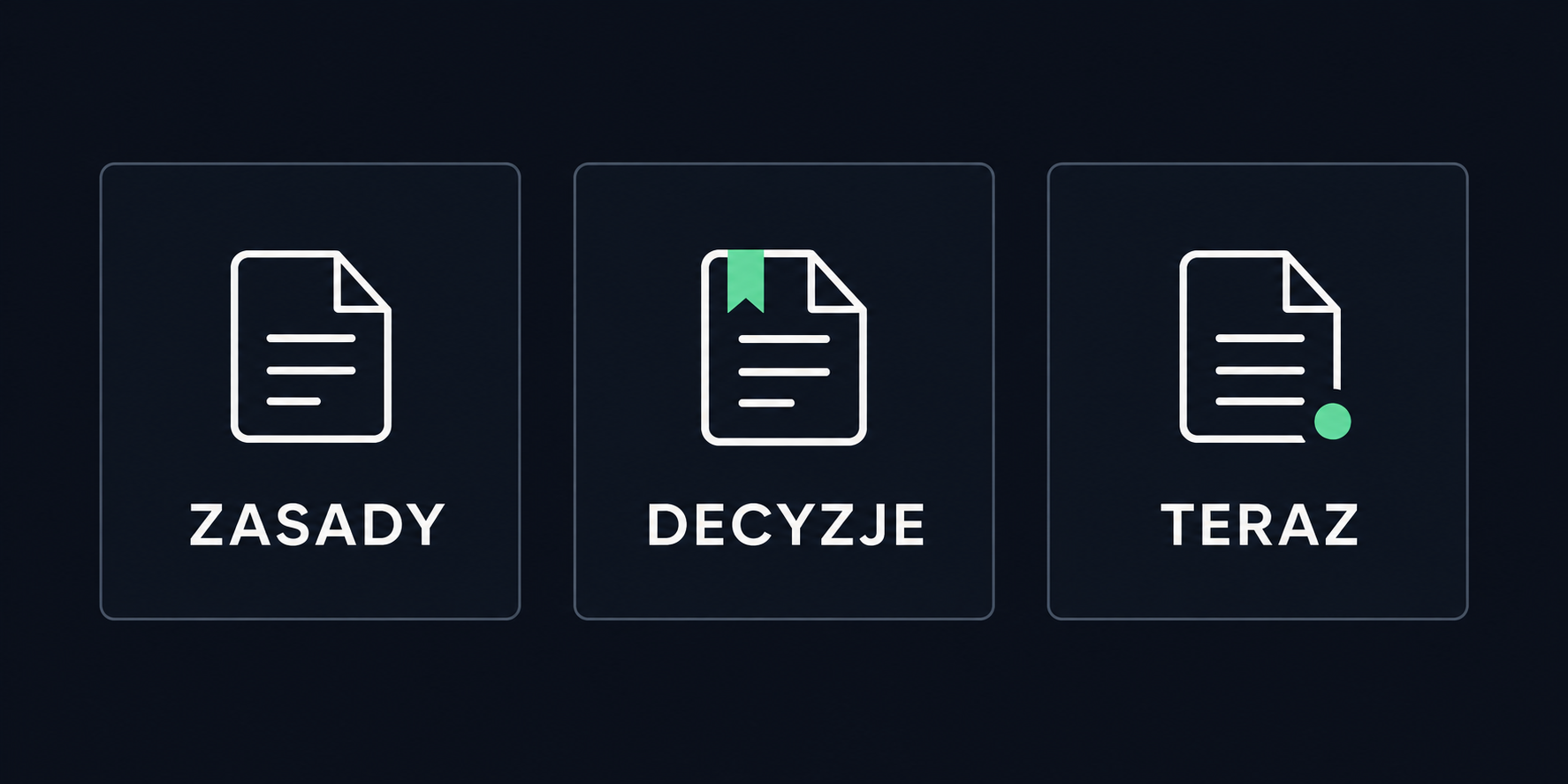
To start, one note with three parts is enough.
Rules describe how we work and how we know the job is done. "Write in an accessible way" leaves a lot of room for interpretation. "For every article, deliver the text, a card description of up to 110 characters and two images; save the files in the working folder" is a much more concrete task.
Decisions keep what was chosen, together with the reason. "We start with exporting to a file, because we download the report once a week and don't need sync." The next agent then has a chance to understand the choice before confidently proposing a rebuild.
Now says where you left off. What works, what's still open, what the next step is. Add a date. "Still need to fix the menu" sounds credible three months later too, when the menu has already been fixed twice.
Once the note grows, split these parts into separate files. Before that, there's no point turning it into a documentation department.
Write down the reason, because a bare "don't touch" ages quickly
This is the detail that makes a big difference.
Say your rules include: "Don't add payments." Six months later you want to sell access. The old instruction still reads like an absolute ban.
"We're postponing payments until we've checked interest in the free version" still makes sense later. You know why the decision was made and what has to change to revisit it.
Same with corrections. "Make this banner without text" applies to one banner. "In this project, thumbnails have no text" sets a rule. If you let the agent turn every comment into a rule, after a few weeks you'll have a constitution based on the fact that a green button once bothered you.
That's why new rules are worth reviewing before you save them. Especially the ones the agent inferred on its own.
A prompt to clean up your decisions
You don't have to reconstruct everything by hand. After a longer session, paste:
Based on this conversation, prepare a short note for further work on the project.

Split it into:
- RULES: lasting requirements for how we work and what a finished result looks like.
- DECISIONS: accepted solutions, their reasons and the conditions that would justify reconsidering them.
- NOW: the current state, open problems and the next step.

Include only decisions I actually accepted. Your suggestions are not my decisions. Do not turn instructions about a single task into rules for the whole project.

If I changed my mind, keep the current decision. Mark unresolved contradictions and missing reasons for clarification; do not guess.

Leave out secrets, login details and unnecessary personal data. Do not save the whole conversation history. Every point should help with the next task.

If project notes already exist, first propose specific changes: what to add, replace or remove. Do not update files without my approval.
Read the result. Remove over-interpretations. Check especially whether the agent recorded its own idea as your decision. It can be very entrepreneurial about approving itself.
Add the finished note to the project instructions in the tool you use, attach it to a new chat, or point the agent to the files to read before starting work. Just putting a document in a folder doesn't guarantee every tool will find and use it. You need to set up how it's connected wherever you work.
At the start of a new session, you can ask the AI to briefly list the rules relevant to the current task. That makes it easier to notice it got an old document or skipped something important.
After that, maintain the note like the rest of the project. Replace outdated decisions, delete finished tasks, add reasons for the bigger choices. The full history can stay in an archive; for day-to-day work you need the current state.
Before your next new chat, write down the one thing you most often have to explain again. That's a good start.